

Winter Skin Rescue: How to Keep Your Legs Smooth and Comfortable All Season
Winter can be beautiful—but for your skin, it’s often the harshest season of the year. Cold temperatures, low humidity, indoor heating, and thick clothing all rob your legs of moisture. The result? Dry, tight, flaky, and uncomfortable skin that feels nothing like it does in warmer months.
If you’re looking for leg skin care tips or wondering how to take care of skin naturally in winter, this guide will help you build a simple, effective routine to keep your legs smooth and comfortable.
Why Winter Causes Dry Leg Skin
Cold climates dramatically reduce humidity levels, which weakens the skin’s ability to retain water. Research shows that low-humidity winter environments significantly impair skin barrier function and lead to dryness, irritation, and flaking (Laughter et al., 2019 — https://doi.org/10.1016/j.jdermsci.2019.08.004).
Your legs—especially the shins—naturally produce fewer oils, making them more susceptible to winter dryness.
Switch to a Rich, Barrier-Restoring Moisturizer
In winter, your skin needs a richer moisturizer that supports the barrier and prevents water loss. Studies demonstrate that moisturizers containing emollients, humectants, and occlusives help repair and reinforce the skin barrier (Proksch et al., 2008 — https://doi.org/10.1111/j.1600-0625.2008.00786.x).
Look for:
- ceramides
- shea butter
- glycerin
- hyaluronic acid
Tip: Apply moisturizer immediately after showering to maximize hydration.
If you notice irritation or red, reactive areas during winter, a soothing cream like HemoZel Cream—designed to calm sensitive skin—can offer additional comfort as part of your daily routine.
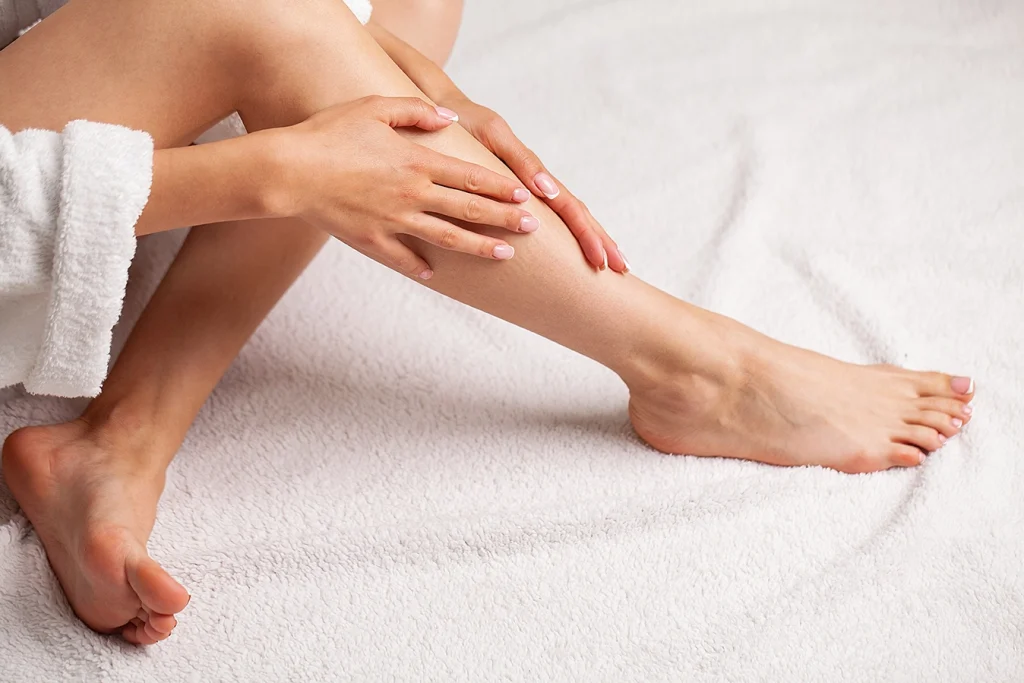
Avoid Long, Hot Showers
It’s tempting to warm up in a long, hot shower, but research shows that hot water strips away the skin’s natural protective lipids, worsening dryness (Berardesca et al., 1998 — https://doi.org/10.1111/j.1600-0536.1998.tb05872.x).
Try adjusting your routine:
✔ Reduce shower time
✔ Use lukewarm water
✔ Switch to gentle cleansers
These changes help your skin retain moisture more effectively.
Exfoliate Gently—Not Aggressively
Regular, gentle exfoliation helps remove dead skin and allows moisturizers to absorb better. However, aggressive exfoliation damages the protective barrier and increases irritation.
Clinical guidance recommends gentle exfoliation once or twice a week to support hydration and barrier repair (Lynde, 2001 — https://www.skintherapyletter.com/eczema/moisturizers-how-they-work/).
Stick to:
- mild exfoliating lotions
- soft washcloths
- avoiding harsh scrubs or friction
Protect Your Legs Indoors
Winter dryness doesn’t just happen outside — indoor heating is a major cause of moisture loss. Research shows that maintaining a humidified environment reduces transepidermal water loss and improves comfort (Lodén, 2003 — https://doi.org/10.2165/00128071-200304030-00005).
To protect your legs:
✔ Run a humidifier
✔ Wear breathable cotton layers
✔ Stay hydrated
✔ Avoid extremely tight fabrics that rub the skin
These small shifts significantly improve winter skin comfort.

Build a Simple Nighttime Leg Care Routine
A consistent routine will help repair and protect your skin barrier throughout the winter season:
- Apply a rich moisturizer
- Massage your legs to stimulate circulation
- Spot-treat irritated areas with a soothing cream
- Wear soft, breathable fabrics overnight
Because skin can become more sensitive in the winter, creams formulated to calm discomfort—like HemoZel Cream—can offer welcome relief for dry, reactive areas.
Final Thoughts
Winter doesn’t have to mean uncomfortable, itchy legs. With a consistent, barrier-focused routine and soothing, hydrating formulas, you can keep your legs smooth, soft, and comfortable all season long.
Small habits make the biggest difference—your winter skin just needs a little extra care.
References
All references below use permanent DOI or stable journal links, ensuring global accessibility.
- Laughter, D., Maymone, M. B., & Vashi, N. (2019).
The impact of cold weather on skin barrier function.
Journal of Dermatological Science, 95(2), 72–78.
🔗 https://doi.org/10.1016/j.jdermsci.2019.08.004
- Proksch, E., Brandner, J. M., & Jensen, J. M. (2008).
The skin: An indispensable barrier.
Experimental Dermatology, 17(12), 1063–1072.
🔗 https://doi.org/10.1111/j.1600-0625.2008.00786.x
- Lynde, C. W. (2001).
Moisturizers: What they are and how they work.
Skin Therapy Letter, 6(13), 3–5.
🔗 https://www.skintherapyletter.com/eczema/moisturizers-how-they-work/
- Lodén, M. (2003).
Role of topical emollients and moisturizers in the treatment of dry skin barrier disorders.
American Journal of Clinical Dermatology, 4(11), 771–788.
🔗 https://doi.org/10.2165/00128071-200304030-00005 - Berardesca, E., Maibach, H. I., & Wilhelm, K. P. (1998).
Irritant dermatitis caused by water exposure.
Contact Dermatitis, 39(6), 308–313.
🔗 https://doi.org/10.1111/j.1600-0536.1998.tb05872.x